Jazz Harmony and Arranging
An analysis of Charles Mingus' "Boogie Stop Shuffle."

Hi everyone! One year ago today, I published the first post for this newsletter. I want to thank you all for your support in reading, commenting, and spreading the word. I hope you find it useful and interesting and that you continue to gain something from it as I continue on. Expect more guitar tips and tricks in the next year with educational how-to demonstrations, more music recommendations, as well as insights and reviews of albums, songs, books, and music documentaries that I find inspirational.
Today I would like to share a research assignment I completed for a class in jazz harmony and arranging at Hunter College (I am in the grad school program for Music Education there). The class focuses on the methods music arrangers use to create depth, interest, color, and momentum within a tune. For this assignment, I chose to write about a tune by Charles Mingus called “Boogie Stop Shuffle,” which he composed and arranged himself.
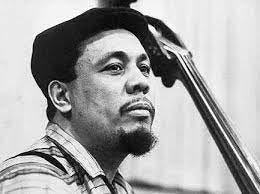
Mingus’ arrangement methods for this song include craftily utilizing a bass line pattern, as well as horn rhythms and melodies to create interest and give the song an emotional arc. Strategically giving the tenors saxophones and the trombones the bass line in the beginning, for example, and then having them create additional melodies with the trumpets later on in chorus 1, leads to melodic contrast and color that sometimes obscures the simplicity of the structure of the song (which is a 12 bar blues), resulting in a sound that mixes blues and jazz flawlessly. Mingus provides extensive use of unison and octaves intervals within the melodies of chorus 1 and 2, helping them stand out and leading to greater emphasis for other harmonies played later on.
“Boogie Stop Shuffle” by Charles Mingus
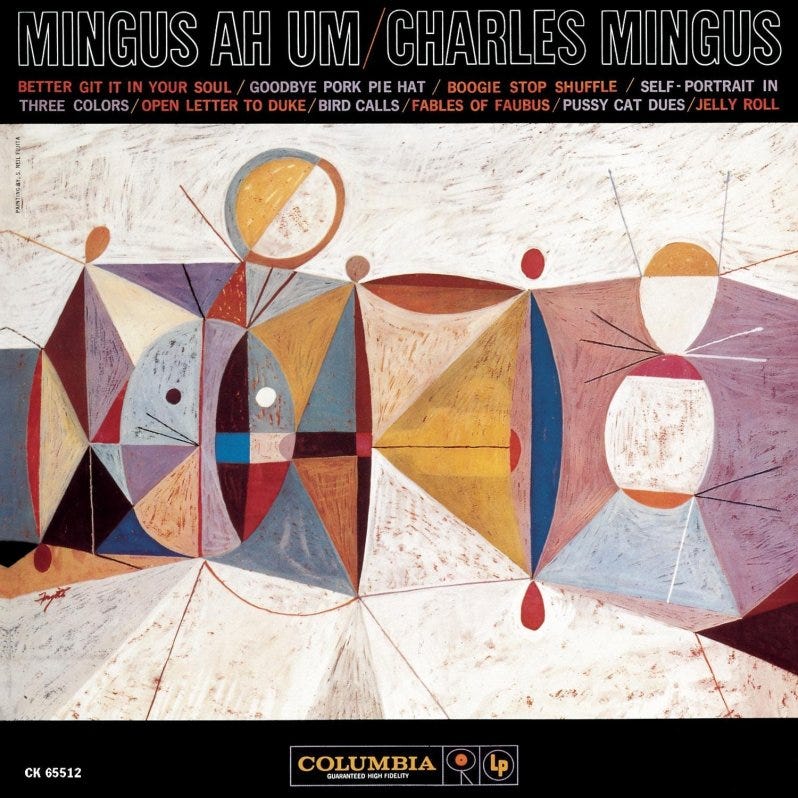
“Boogie Stop Shuffle” is a speedy, 12 bar blues from Charles Mingus’ 1959 album, Mingus Ah Um. Born in 1922 in Arizona, Mingus began listening to jazz at a young age, especially taking a liking to Duke Ellington on the radio. He studied double bass with Herman Reinshagen (bassist for the New York Philharmonic) and composition with Lloyd Reese before beginning to tour in the 1940s with Louis Armstrong and Lionel Hampton. In the 1950s he began recording albums and playing with other well known musicians of the time such as Charlie Parker, Miles Davis, Art Tatum and Duke. He also began to solidify his role as a band leader, which isn’t seen very often for a bassist. Throughout his lifetime, he toured extensively throughout Europe, Japan, Canada, South America, and the United States, all while recording over 100 albums and writing over 300 scores. In 1977, he was diagnosed with Amyotrophic Lateral Sclerosis and died in 1979 at the age of 59 years old.
Mingus Ah Um was released in 1959 as his 12th album. The track, “Boogie Stop Shuffle” was composed and arranged by Mingus. The title describes the style of the tune, a boogie-woogie with a stop-shuffle feel, which can be heard most prominently in the opening measures of the tune when the piano, bass, and horns perform the bass line in unison. They all play quarter notes together and then stop together on the third beat of each measure.
Mingus is said to have described the tune as a tribute to the Kansas City Jazz tradition and its spirit of improvisation, a tradition that was built on writing danceable music, with a strong focus on the segregated black community at the time in the city. Originators of this style include bands like the Bennie Moten Orchestra in the 1920s. Later on, Count Basie and Charlie Parker expanded on this style, developing bebop and featuring virtuosic soloists in improvisational settings.
“Boogie Stop Shuffle” follows an ABCAB form arranged by Mingus to create different moods with interesting variations specifically in the rhythm section and in the melodies played by the horns. There is the intro, followed by a chorus 1 (A), chorus 2 (B), solos (C), chorus 1, chorus 2, and outro.
During the intro, the rhythm section (drums, piano, and bass), the tenor saxes, and the trombones play the bass line in unison which characterizes the feel and mood of the song. This bass line is featured throughout the entire piece. After a full 12 bar cycle of just the bass line, the piano and bass continue with that while the saxes and trombones switch to playing quick, staccato, and accented harmonies on beat three of each measure for the first two measures of the one chord (B flat minor) and then the first two measures of the four chord (E flat minor) in the progression. These accented harmonies on the third beat accentuate the stop-time that Mingus employs in this song, which is reminiscent of the song title. Below (in the last two measures) is an example of the harmonies described.
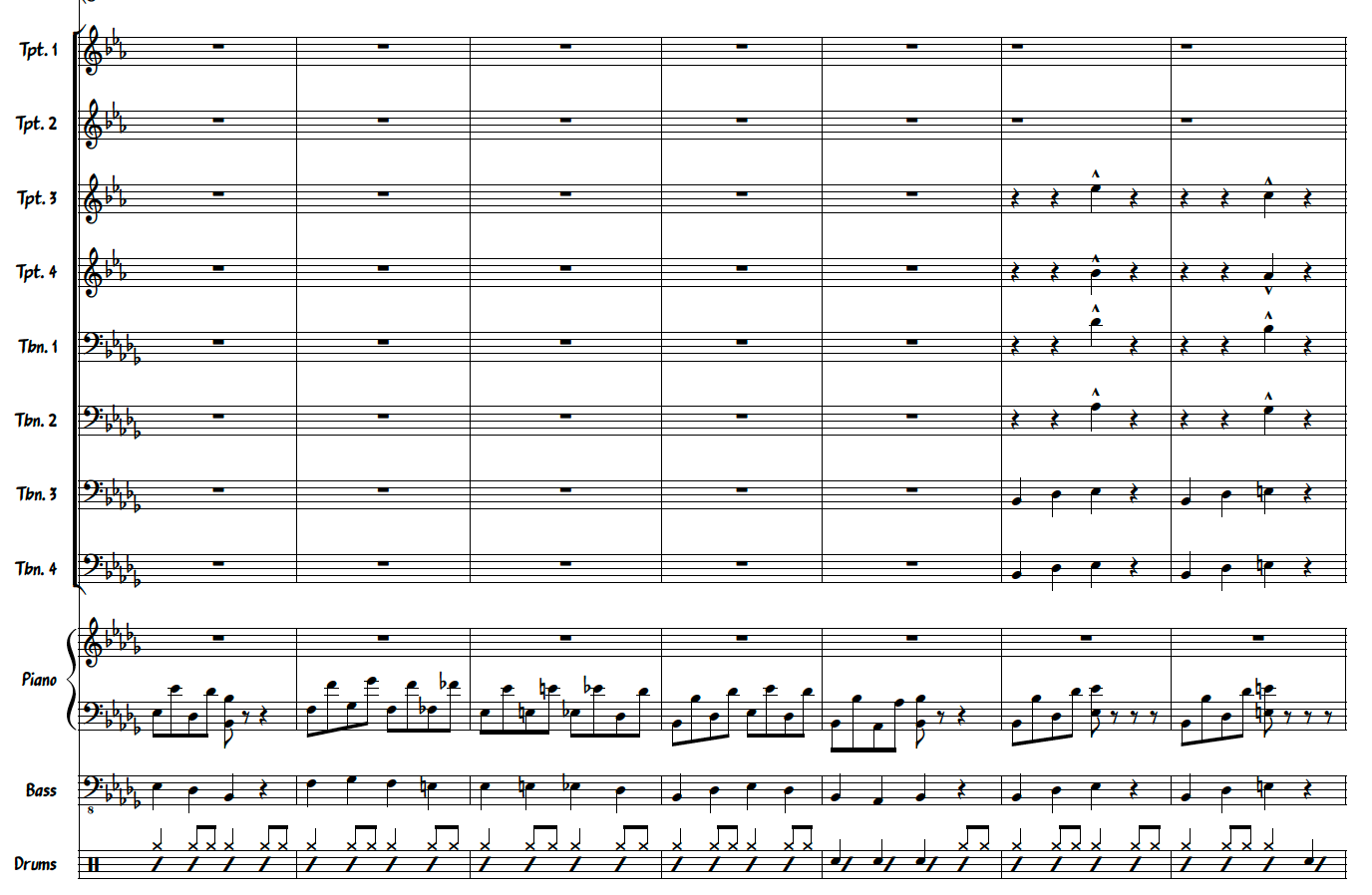
In the example above, trumpets 3 and 4 as well as trombones 1 and 2 accent beat 3 in the first 2 measures of the 12 bar cycle. The first measure harmonies outline an E flat minor 7 chord as trumpets 3 and 4 play the 7th and 11th chord tones (D flat and A flat) while trombones 1 and 2 double them. The second measure of horn harmonies also outline the E flat minor chord with the 5th (B flat) in trumpet 3 and trombone 1, and the 3rd (G flat) in trumpet 4 and in trombone 2, providing some dissonance on top of the E natural note (b9) in the bass line. But release of this dissonance comes quickly as the bass line reverts to its melodic outline of the one chord next (B flat minor). During the last four bars of this section of the 12 bar blues cycle, the bass and piano outline the V (F), iv (E flat), i, i (B flat) progression with the consistent bass line as the horns change rhythms and play mostly descending half note harmonies (see below).
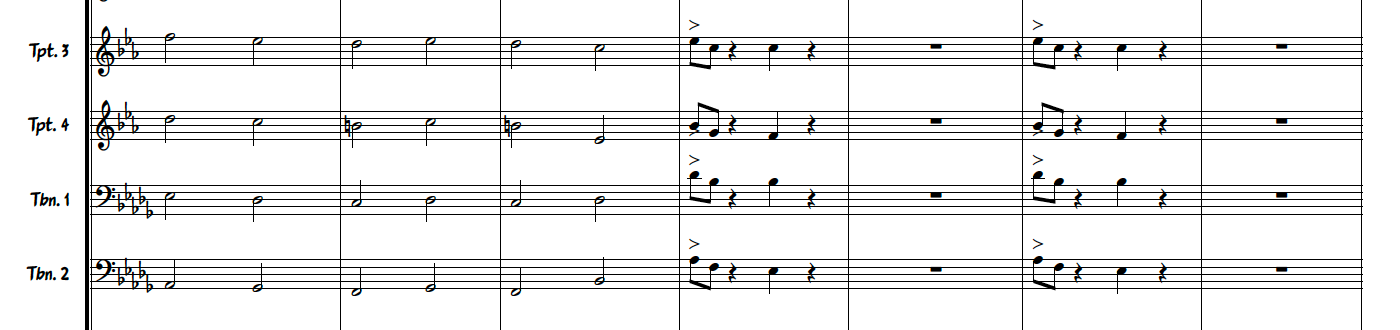
There are four measures total of these half note harmonies. The first measure begins with trumpet 3, 4, and trombones 1 and 2 playing the 7,5,7,3 respectively of the minor five chord (F minor 7). This then ascends and descends chromatically before moving to the minor four chord (E flat minor 7), with the horns playing the same pattern: 7,5,7,3. The next measure changes up the pattern on a B flat minor chord, with the horns playing 9,7,9, and 5, which then ascends and descends chromatically again, before resolving to a B flat minor chord with the horns really stressing the tonic (B flat minor: 1,3,3,1).
Chorus 2 begins when the 12 bar progression repeats next, and the alto and tenor saxes, as well as trumpets 1 and 2 carry a new melody in which all instruments are in unison, except for trumpet 2, which is an octave above the rest of the horns. Here also, is the first marking of dynamics, which read “fff.”
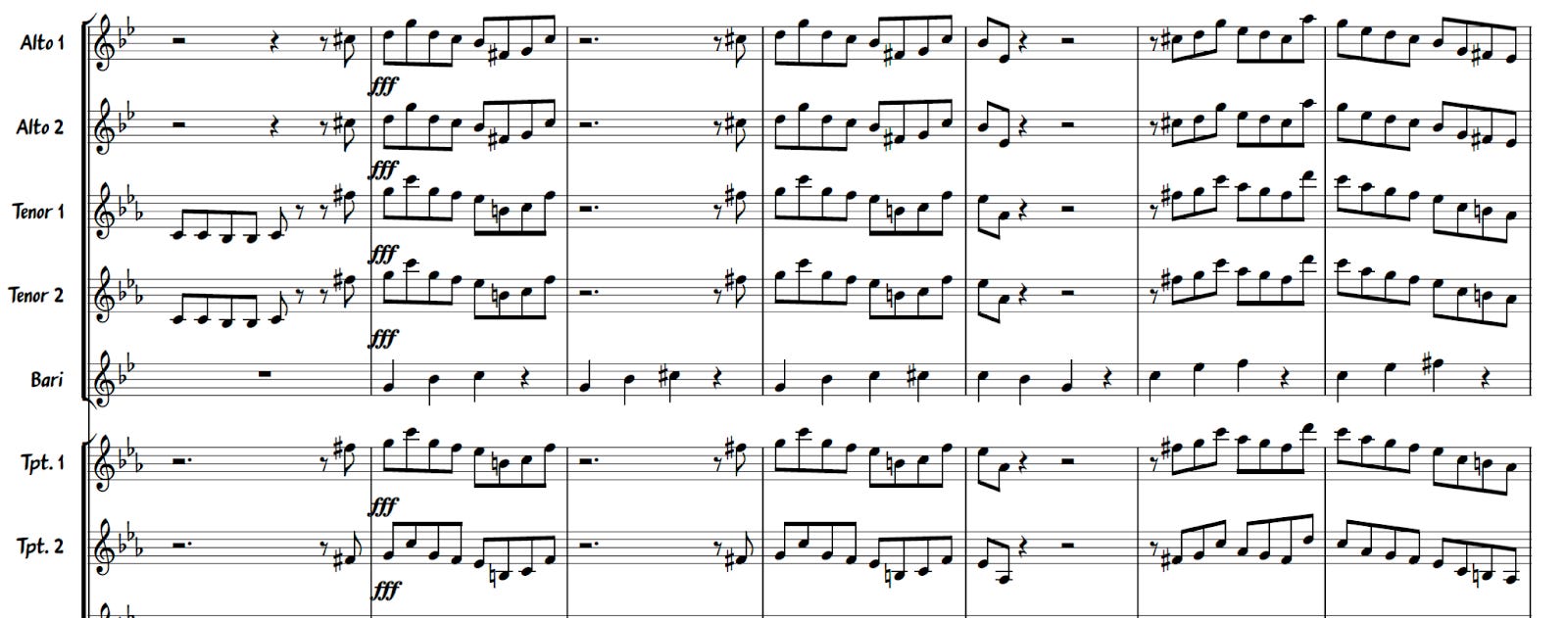
At the end of most of the melodic phrases in this section, the horns play whole notes, some of which provide an interesting contrast to the previous fast melodies, leaving the listener to wonder where the tune will go next. One of these whole note examples is presented below, and it is consistent with the doubling of the melody as described above, where all horns here play a G note.
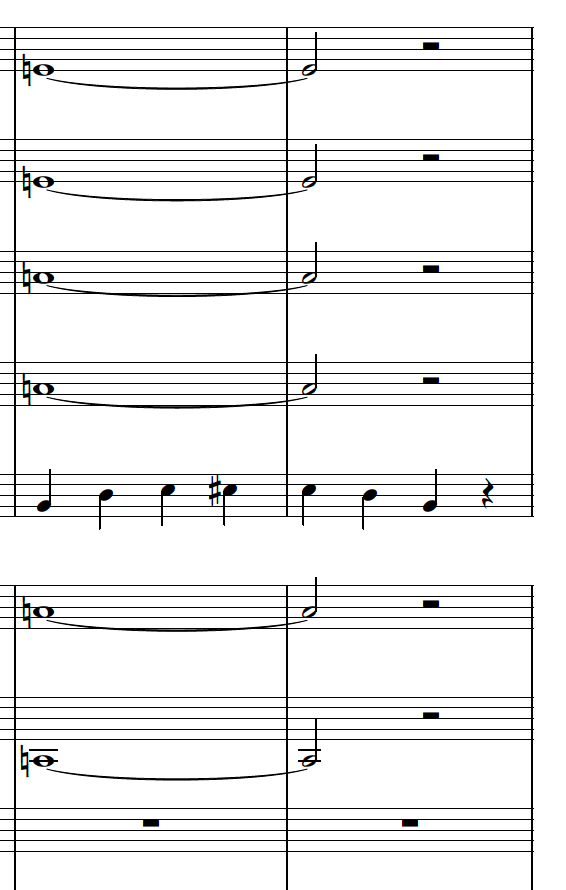
The next whole note consists of all E’s in the horn section (see below). The use of unisons are pervasive in this arrangement.
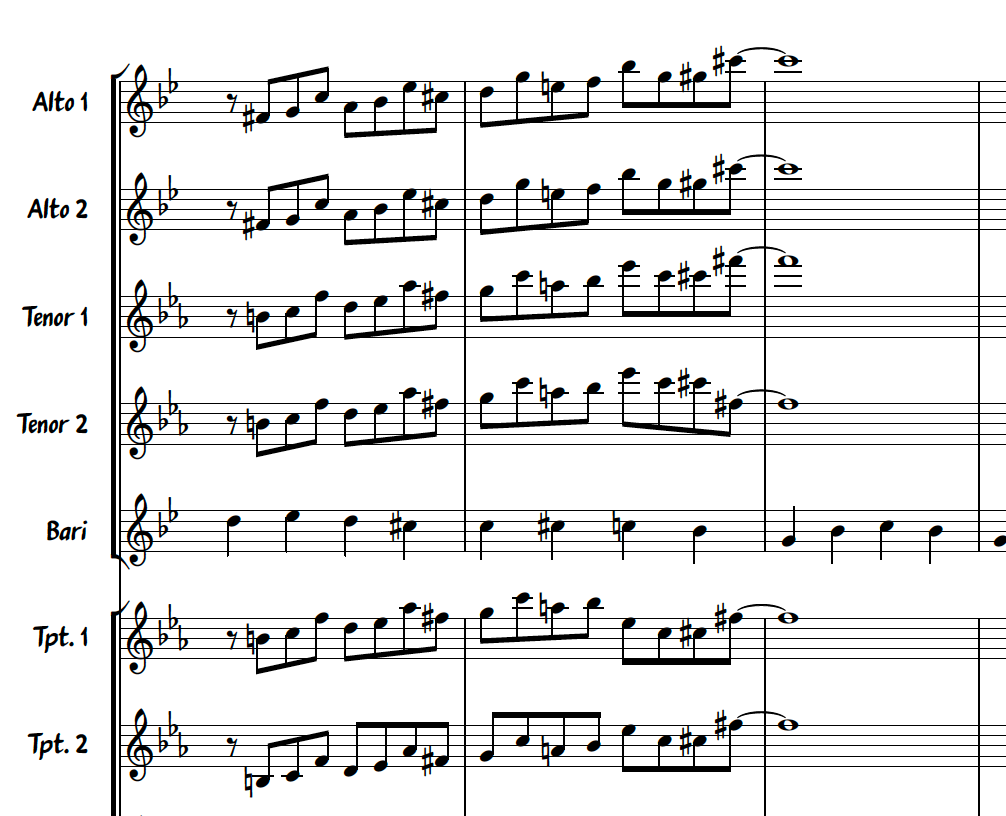
While trumpets 1 and 2, the altos, and the tenors play the melody of this B section, underneath, the bari saxophone, trombones, piano left hand, and bass play the same bass line from before. However, chorus 2 is repeated once and during the repeat, the baritone saxophone and trombones drop out and the bass and piano begin improvising, straying away from the original bass line, but still sticking to the 12 bar blues form. It is important to note the rhythm sections’ role in this part of the tune. As the bass and piano stray away from the familiar bass line pattern, this is also the first time the listener can hear the right hand of the piano comping and adding rhythmic variety and color along with the drums between horn lines (see measure 61-63 below as an example of the piano voicings of the B flat minor 11 chord, which the drummer accents rhythmically).

This opens up the sound a bit, as the tune is now no longer constricted to the same repeating bass line, and it provides a seamless segue into the the first solo, which is played by an alto saxophone for 24 bars. Behind the saxophone, the rhythm section continues in the same improvisational manner as before, while the tenor saxophones and trombones provide rhythmic color throughout. Most of the time, they are playing the first three notes of each measure to reinforce the pulse and feel of the blues progression. During this time, the trombones are playing the 3rd of the B flat minor chord and the tenors are playing the 1.
The next solo is the piano, which lasts for 48 bars. When it begins, the bass, trombones and saxes return to the original repeating bass line as shown in the first diagram, providing an ominous feeling of something to come. Once the piano solo is over, the horns continue the bass line for another 12 bars as the drums stray away from the swing pattern and begin to improvise in addition to an alto saxophone providing some color with long drawn out notes on top. After this, all instruments drop out except for the drums, which solo for a full 12 bar cycle before returning to chorus 1 again, then chorus 2, and finally, the outro. Here, chorus 2 is cut short unexpectedly, on the eleventh measure of the second repeat of the 12 bar cycle in this section, where time stands still as the horns hold out their notes, the drums begin to quickly improvise various fills, and the horns improvise melodic lines, adding to a chaotic-sounding, but climactic end to the tune. The horns then drop out, and the drums continue to add more fills and ultimately end the tune with two cymbal crashes.
So what did we learn from this tune? First, it is important to just listen and start picking out the different instruments that can be heard; when they are playing or not, how that fits into the overall form structure, and if they are carrying the melody, providing rhythm, soloing, or adding harmonies. All of these arranging techniques are choices that were purposefully made by Mingus to add to the overall depth and momentum of the song. Any of these types of methods can be utilized in a number of ways to enhance the arrangements or harmonic interest of original compositions, or to put a creative spin on a cover song.
What I’m Listening to This Week:
Charles Mingus - Mingus Ah Um
Miles Davis - Kind of Blue
Peter Tosh - Wanted Dread or Alive
Stephen Marley - Mind Control